
The Invisible Ropes We Learn in Childhood
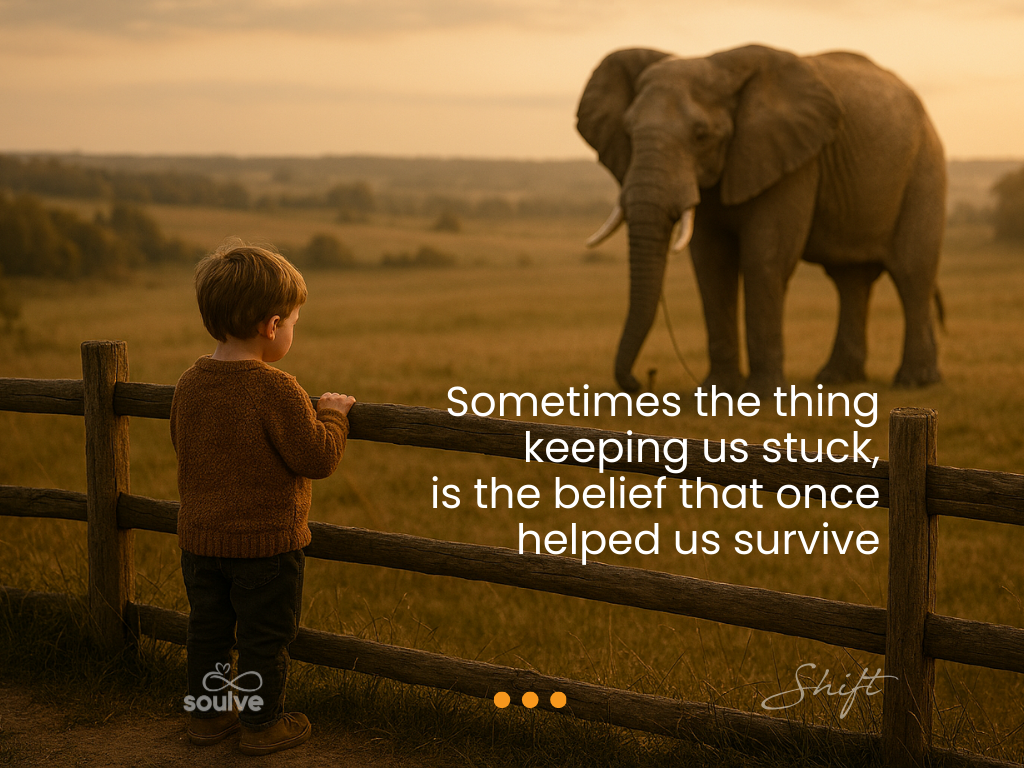
Sometimes the thing keeping us stuck…
is the belief that once helped us survive.
– Soulve
When elephants are young, trainers tie them to a small wooden stake with a rope. The baby elephant pulls and struggles, tries to escape. But the rope holds, and eventually the elephant stops trying.
Years later that same elephant is enormous and powerful enough to rip the post out of the ground without effort. But it doesn’t.
Because somewhere along the way it learned a quiet conclusion:
I can’t break this rope.
And from that moment on, it never tries again.
Human beings do something very similar. Over time we develop beliefs about how the world works and what we’re capable of. Some of these beliefs are useful, some are protective, but some become invisible stakes that quietly run our lives.
One of mine was simple.
I have to do everything myself.
For years that belief showed up everywhere — at work, at home.
I would take things on, get overwhelmed, and then feel furious that no one was helping me. If someone did offer help, I would watch closely, notice all the ways it wasn’t being done “the right way,” and take the task back. Which meant I ended up doing everything anyway. And then came the resentment.
You can probably see the loop.
Take responsibility → feel overwhelmed → reject imperfect help → end up alone with the work → feel unsupported.
The belief proved itself over and over again, or so it seemed.
The moment the rope loosened came during one of my journalling “stacks.” Stacking is basically a structured rant where I write everything I’m thinking and feeling without censoring it — the unfair thoughts, the sharp judgments, the things I would never normally say out loud.
It isn’t pretty. It’s raw.
When I read some of those pages back years later I sometimes cringe, because you can practically feel the rage and bitterness dripping off the paper. The words are messy, dramatic, sometimes downright unfair.
But that’s the point.
Once the emotional storm is out on the page, something interesting happens. The intensity drains away just enough for me to read it back with a little distance — and suddenly the patterns hiding inside the anger start to reveal themselves.
One day, reading back a stack about work, I suddenly saw the belief sitting right there in the middle of the page:
I have to do everything myself.
And then another uncomfortable truth followed close behind it.
- I wasn’t just believing this story.
- I was actively reinforcing it.
Whenever someone tried to help, I corrected them. If something wasn’t done exactly the way I would do it, I took the task back. And when people offered help, I often declined, telling myself it would take just as long to explain it as it would to do it myself.
I thought I wanted help, but in reality I was quietly rejecting it over and over again. I was asking for support with one hand and pushing it away with the other.
- No wonder I felt alone with the workload.
- No wonder resentment kept creeping in.
- The rope wasn’t just around my leg.
- I had been holding it tight.
Once I saw the pattern, things began shifting surprisingly quickly. Not overnight, but noticeably.
At home I started letting my daughters cook dinner without hovering over their shoulders correcting every step. At work, my colleagues and I experimented with a different rhythm: they would create a quick first version of something, and I would come in afterwards to refine the details and polish it.
Instead of trying to do everything from scratch myself, we started playing to our strengths.
The work got done faster.
And the world, quite shockingly, did not fall apart.
That single moment of awareness fixed most of the problem, because once you see the rope, you can’t completely pretend it isn’t there anymore. You begin catching yourself in the act of tightening it.
Later, when I sat with the belief for a while longer, something else became obvious.
Of course I learned to rely on myself.
I grew up in a divorced home. Holidays were often spent alone while my mom worked. I stayed home by myself at night with neighbours as a backup while my mom was at her second job, and at ten years old I was sent to boarding school. Getting home for holidays or visiting my dad meant flying across the country as an unaccompanied minor.
Independence wasn’t a personality trait.
It was a survival skill.
That belief — I must do everything myself — once made perfect sense. It helped me cope and navigate a world where I often had to figure things out on my own.
But beliefs that help us survive childhood don’t always serve us in adulthood. Sometimes they quietly become the invisible ropes that keep us stuck long after we have the strength to pull free.
The work isn’t about blaming those old beliefs or trying to shame them away. They got us here.
The work is simply noticing when they are still running the show — and gently loosening the rope.
Because more often than not, the stake holding us in place isn’t nearly as strong as we once believed.
Reflection:
Is there an area of your life where you quietly believe:
“I have to do this alone.”
Pause for a moment and ask yourself a curious question.
Is that belief still true today…or is it simply a rope you learned not to pull against?
